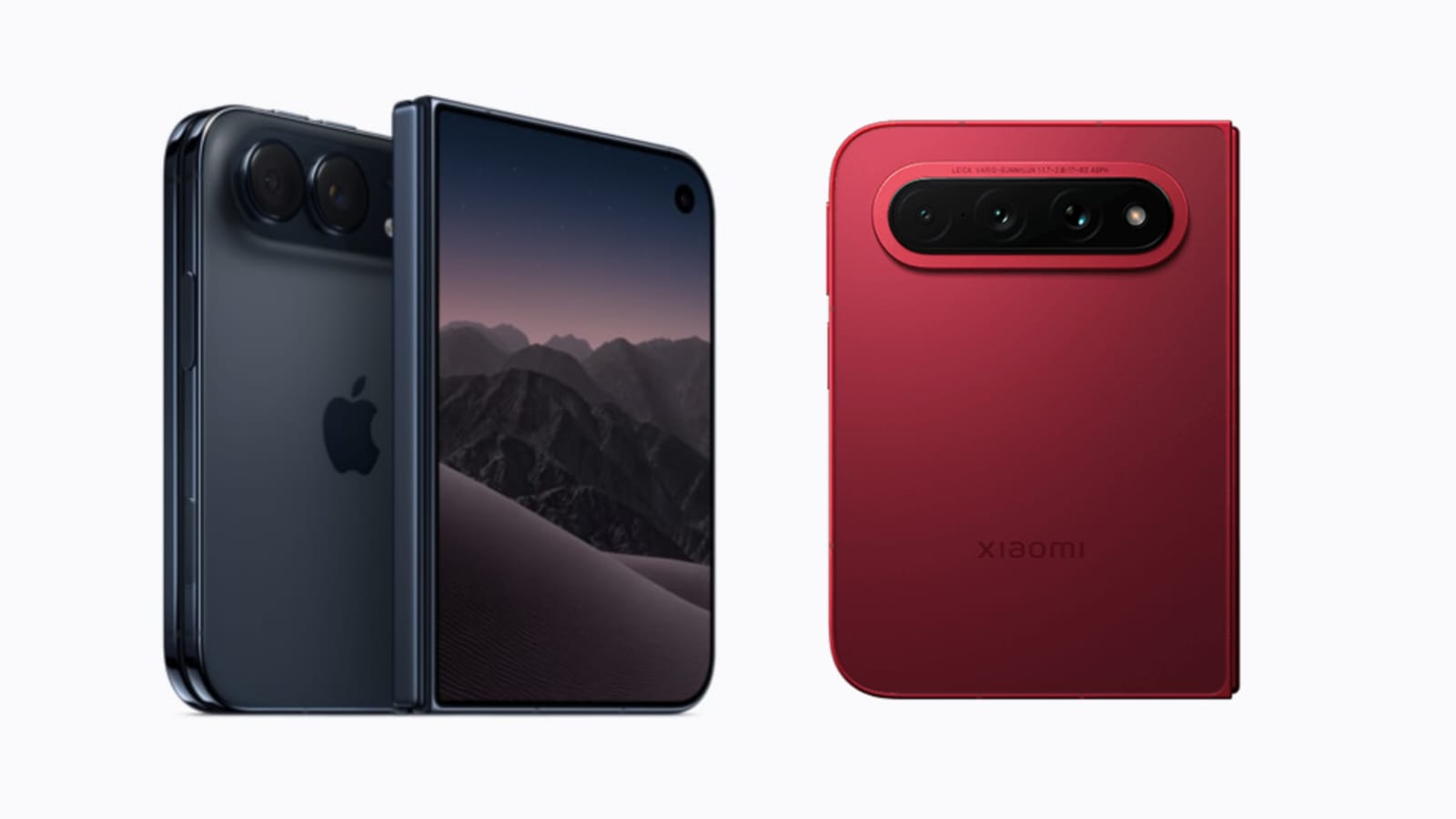
Apple iPhone Duo and Xiaomi 18 Fold are both foldable phones that offer premium designs and powerful hardware. Xiaomi arrived first with surprisingly aggressive specifications.
Apple followed with deeper software and ecosystem integration. The real difference appears beyond their similar folding designs.
Related Article: Download All Apple iPhone Duo Wallpapers in 4K
Key Takeaways:
- Xiaomi wins hardware: Better cameras, battery, brightness, charging.
- Apple wins software: Better integration, durability, long-term support.
- Pricing matters: Xiaomi costs substantially less than Apple.
Apple iPhone Duo and Xiaomi 18 Fold Design
At first glance, these phones look remarkably similar. Both use short, wide book-style folding designs. Both measure exactly 117.8mm tall when unfolded. Their overall dimensions remain extremely close too.
Xiaomi Is Lighter And Thinner
The Xiaomi 18 Fold measures just 5.02mm unfolded. Apple’s Duo measures slightly thicker at 5.2mm. Closed, Xiaomi remains thinner than Apple’s foldable. The difference becomes barely noticeable inside pockets.
The bigger difference appears in their weights. Xiaomi weighs only 219 grams overall. Apple’s Duo weighs considerably more at 254 grams. That creates a noticeable 35-gram difference between them.
Apple uses premium Grade 5 titanium throughout its frame. Xiaomi instead uses lightweight seven-series aluminium construction. Apple also uses a titanium hinge cover. Its hinge contains more than 100 components.
Xiaomi uses its three-link Dragon Bone hinge. Xiaomi tested 10,437 simulated drop angles during development. The company reportedly made 492 design changes. Its phone carries a 1.2-meter drop rating.
Displays Take Different Approaches
Apple offers sharper OLED displays on paper. Its inner screen measures 7.6 inches diagonally. Xiaomi’s inner screen measures 7.58 inches. Both support refresh rates reaching 120Hz.
Xiaomi has one major brightness advantage here. Its displays can reportedly reach 4,000 nits. Apple reaches 3,000 nits outdoors instead.
Apple fights reflections using nano-texture technology. This makes its inner screen resemble paper. Xiaomi’s inner display remains glossy instead.
The biggest visual difference involves camera cutouts. Apple’s inner camera sits completely underneath the display. Xiaomi uses a visible hole-punch camera instead.
iPhone Duo and Xiaomi 18 Fold Performance Comparison
Apple gives the Duo its powerful A20 Pro chip. This processor uses a 2nm manufacturing process. It features six CPU cores and seven GPU cores. Apple also includes dual 16-core Neural Engines.
Xiaomi uses its new XRING O3 processor. This chip uses a 3nm manufacturing process. Its ten-core CPU reaches speeds up to 4.35GHz. The processor includes a 16-core GPU too. Its NPU reaches an impressive 200 TOPS rating.
Software Creates The Bigger Difference
The Duo runs Apple’s iOS 27.1 software. Apple redesigned iOS around the folding experience. Navigation moves toward the display’s sides. The Dynamic Island also changes its position.
Split View finally brings multitasking to iPhones. Users can run two apps simultaneously. They can also save frequently used app pairs. StandBy works on either screen without charging.
Xiaomi runs HyperOS 4 with Android 17. It supports up to six simultaneous applications. Users can also add floating windows above them. More than 200 apps receive fold-specific layouts.
Xiaomi also offers PC-class applications for productivity. WPS and CapCut receive wider-screen adaptations. Its Inspiration Ball adds useful AI features. That feature arrives through a September software update.
However, Xiaomi’s Chinese software has limitations. Google Play services are unavailable out of the box. Google Maps and Gmail are also missing. Users must sideload these applications themselves.
iPhone Duo and Xiaomi 18 Fold Cameras Comparison
This is where Xiaomi becomes extremely interesting. The 18 Fold carries a 200MP Leica main camera. It uses a large 1/1.56-inch sensor. Optical image stabilisation is also included.
A 50MP periscope camera provides 3.5x optical zoom. It also supports seven-times optical-quality cropping. Another 50MP camera handles ultrawide photography duties. Xiaomi supports 8K recording at 24fps. Slow-motion recording reaches an impressive 960fps.
Apple takes a simpler camera approach instead. The Duo uses two 48MP rear cameras. Its main camera uses an f/1.6 aperture. The ultrawide camera also carries 48MP resolution.
Apple relies heavily on computational photography here. Its 2x zoom comes from main-camera cropping. Video recording reaches 4K at 120fps. Dolby Vision further improves supported video recording.
Folding Creates Interesting Camera Features
Apple adds several clever camera-focused features. Duo Preview shows subjects on the outer display. Smart Take captures moments when everyone looks ready. Kid Cue uses Peanuts animations for children. Dual Capture records front and rear cameras together.
Duo FaceTime also uses both phone screens. Xiaomi offers similar outer-screen preview functionality. Its closed phone becomes a 4:3 viewfinder too.
Battery, Charging And Connectivity
Xiaomi clearly wins the battery capacity battle. The 18 Fold packs a massive 6,000mAh battery. Its rated capacity stands at 5,875mAh. Wired charging reaches 67W speeds. Wireless charging reaches 50W speeds.
Apple uses a dual-battery architecture instead. The company does not publish battery capacity. The Duo offers 24 hours of mixed-display usage. Inner-screen video reaches up to 31 hours. Outer-screen video reaches up to 44 hours.
Apple reaches 50 percent charge within 20 minutes. This requires Apple’s separate 60W charging adapter. MagSafe wireless charging reaches 25W maximum. Xiaomi includes its charger inside the box.
Apple Has More Connectivity Features
The Duo supports satellite emergency communication features. These include Emergency SOS and Messages. Find My and Roadside Assistance also work. Apple also provides Wi-Fi 7 and Bluetooth 6.
Xiaomi offers Wi-Fi 7 with multi-link support. Bluetooth 6.0 and UWB are also included. It additionally provides NFC and infrared functionality.
The SIM approach differs dramatically between both phones. Apple uses eSIM exclusively across every market. Xiaomi provides two physical nano-SIM slots. The Duo stores eight or more eSIM profiles.
Price And Availability
Apple’s iPhone Duo starts at $1,999. Its highest 2TB version reaches $3,199. Xiaomi’s base model starts at CNY 10,999. Its Ceramic Edition reaches CNY 15,999.
Pricing Breakdown
iPhone Duo:
- 256GB: $1,999
- 512GB: $2,199
- 1TB: $2,599
- 2TB: $3,199
Xiaomi 18 Fold:
- 12GB/256GB: CNY 10,999
- 12GB/512GB: CNY 11,999
- 16GB/512GB: CNY 12,999
- 16GB/1TB: CNY 14,999
- Ceramic 16GB/1TB: CNY 15,999
Xiaomi currently sells the 18 Fold only in China. International availability may arrive before 2026 ends. Apple begins Duo preorders on October 16. Retail sales begin October 23 across 70-plus countries. Another 28 countries follow on October 30.
For buyers importing either phone, costs increase. Shipping, taxes, duties, and reseller margins matter. Xiaomi’s Chinese software creates additional complications overseas. Apple offers a familiar iOS experience globally.
The End Note
The Xiaomi 18 Fold delivers impressive hardware value. It wins on cameras, battery, brightness, and charging speed. Apple counters with stronger software and durability.
Its ecosystem also provides better long-term support. Xiaomi looks more convincing today for hardware value.
For the latest tech news, follow Hogatoga on Twitter, Facebook, and Google News. For the latest tech-related videos, subscribe to our YouTube Channel and Newsletter.